Saturday, June 2, 2012

Brain Teasers: Equation Gone Wrong

Hey all! Can anyone figure out what went wrong?

a = b
ab = b^2
ab - a^2 = b^2 - a^2
a(b - a) = (b - a)(b + a)
a = b + a
                                                          a = b;          a = a + a
a = 2a
1 = 2?

What happened?


Solution: Look at Steps 4 and 5 in my justification above:

a(b - a) = (b - a)(b + a)
a = b + a

If a = b, then b - a = 0, so the real justification would be:

a(0) = (0)(b + a)
0 = 0

This means I divided by 0 in my justification, which is impossible according to the laws of mathematics.

Hope you enjoyed!

Fast Facts

Hey! Here are some fun math tips.


Fact 1:

1 = 1
1 + 3 = 4
1 + 3 + 5 = 9
1 + 3 + 5 + 7 = 16
1 + 3 + 5 + 7 + 9 = 25

See? The sum of odd consecutive numbers starting from 0, will always be a perfect square number no matter how far you go. Check it out!

Fact 2:


4% of 100 = 100 % of 4
6% of 38 = 38% of 6
5% of 10 = 10% of 5
7% of 50 = 50% of 7

Catch the drift?

Fact 3:

(a * b) * (c * d) = 100(ac) + 10(ad + bc) + (bd)

This is just the Rainbow Method simplified into an equation!

Fact 4: 


To square 2 digit numbers ending with ‘5’ (Example: 75 × 75)
1.  Take the first digit ‘7’ multiply by the number after ‘7’ => 7 × 8 = 56 
Now add 25 after the number. 56(25) = 5625
Hope you all enjoyed!

Wednesday, April 11, 2012

Factoring Quadratic Expressions: Box Method

Hello all. Sorry for not posting a blog in a while. I've been having a lot on my hands and I couldn't find the time to get to this. Now I do :). Today, I will be teaching you all a technique on how to factor quadratic expressions in the form ax^2 + bx + c.

The example we will be using is: 2x^2 - 5x + 3.

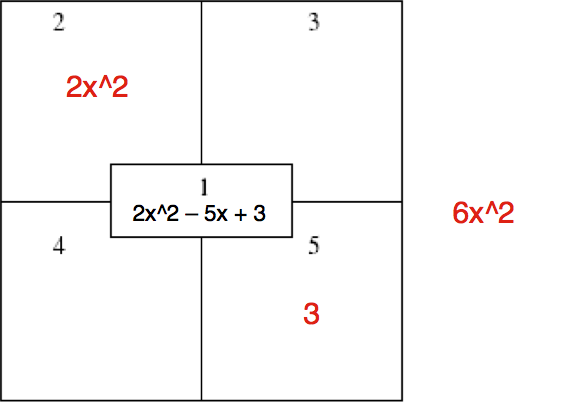
To factor this expression, we will use the Box Method. First, create a box with 5 squares.

Step 1: Insert the first term in the 2nd square and the last term in the 5th square. Then multiply those terms together, and put the product to the side of the box as shown:
Step 2: Now find two terms that multiply together to get the product on the right, BUT ALSO, add up together to get the middle term in the original expression. In this case, we need to find two terms that if multiplied, get us 6x^2, but also if added together, get us -5x. Put each term on boxes 3 and 4. It doesn't matter which term goes in which box.

Step 5: Now its time to calculate the factorization of this equation. First, calculate the GCF of the two terms of the top 2 boxes and put the GCF to the left of Box 2. Then do the same thing with the bottom 2 boxes and put the GCF to the left of Box 4. (I made a typo: the GCF next to Box 4 is -3, and not 3).
Step 6: Now you have to calculate the GCF of the two terms of the left 2 boxes and put the GCF under Box 4. Then do the same thing with the right 2 boxes and put the GCF under Box 5. 
Step 7: Now we know the numbers of our factoring. Just put parentheses around the GCFs to the left of the square to get the first "term" in the factoring, and put parentheses around the GCFs under the square to the get the second "term" in the factoring.

Therefore, if we factor 2x^2 - 5x + 3, we get: (2x - 3)(x - 1). 

Thanks for reading this method on factoring! If you have any questions, please post comments down below.

Tuesday, November 1, 2011

Multiplication: Base Method 1

Hello. Today I am going to teach a new two way trick on how to do the Base Method. The Base Method is a way to use bases to multiply numbers. Some people prefer the Rainbow Method over the Base Method, but that is up to you.

Example: 98 x 95

Step 1:  First, find the closest base of the two factors that is higher than the two factors. A base is a number that is either 10 or a power of 10. This includes 100, 1000, 10000, etc because they are all powers of 10. In this case, the closest base of the two factors that is higher than the two factors is 100.

Step 2: Pick one of the factors in the problem. Figure out that factor minus the base you chose in the previous step. Place that number on top of the factor you chose in the beginning of the step.
                                                                                             -5
                                                                     Example: 98 x 95
As you can see, 95 (the factor I chose) - 100 (the base) =-5. Therefore I put that number on top of 97.

Step 3: Repeat Step 2 for the other factor in the problem.
                                                                                     -2       -5
                                                                     Example: 98 x 95
Step 4: Now do something I like to call "cross-adding". It's when you pick any number and add it to whatever is diagonal from it. For example, if you choose 95, you would add -2, because -2 is diagonal of 95, as shown below:
                                                                                    -2     -5
                                                                     Example: 98 x 95

95 is diagonal of -2. 95 +-2 = 93.

That sum of those 2 numbers is the first 2 digits of your answer.
                                                                 
                                                                  -2     -5
                                                  Example: 98 x 95                Answer: 93

Step 5: Pay attention to your base. Count the number of zeros your base has. This tells you how many digits your answer has left.

                                                      Base: 100.                     Answer: 93_ _

Step 6: To figure out the last 2 digits of your answer. Simply multiply the 2 numbers at the top.
                                                                                     -2     -5
                                                                    Example: 98 x 95   
                                                                        -5 x -2 = 10

                                                                     Answer:       9310

The answer is 9310. Hope this helped! If you have any questions, please post a comment below about it. Thanks!
             

Monday, October 31, 2011

Multiplication: Rainbow Method

 Hello! Today I will teach you how to multiply quicker than you already can with a method known as the Rainbow Method. This is a shortcut on how to multiply any 2 digit number with any other two digit number.

Example: 23 x 55

Step 1: To calculate the first two digits of your answer, multiply the first digit of the first factor to the first digit of the second factor. Then leave a space after the answer.

23 x 55     Answer: 10_

Step 2: To calculate the last digit of your answer, multiply the last digit of the first factor to the last digit of the second factor. If its a two digit number, carry over the tens place digit to the space before.
                                                                                       1
23 x 55        Answer: 10_5


Step 3: Now, to calculate the final digit of the answer (the space) you will use the Rainbow Method. Simply multiply the first digit of the first factor to the last digit of the last factor, and add that to the product of the last digit of the first factor to the first digit of the last factor, as shown below:


This shows that you are adding "2 x 5"(as shown in the outer rainbow line on the picture) to "3 x 5"(as shown in the inner rainbow line on the picture). The sum is 25. This is what you put in the space in the answer. Since it is a 2 digit number, carry over the tens place digit of this number to the place before in the answer.

                                                                                      21
23 x 55          Answer: 1055 

Step 4: Now do your finishing touches on your answer by adding the digits you carried over to the digits below them, as shown below.

                                                                                                                   21
23 x 55          Answer: 1055 
                                                                        
                                                                          True Answer: 1265

The answer is therefore 1265. I hope you've learned how to use this method! If you have any questions, please post a comment below about it. Thanks!

Sunday, October 2, 2011

Division: Dividing Fast!


This video will teach you how to divide any number by 9.

Thursday, September 22, 2011

Multiplication: "Odd" Theory

Here's an interesting theory I expanded on. I hope you like it! In order to do this trick however, you need to know your perfect squares.

If you want to know the answer to a multiplication problem such as:

                                                            11 x 19
This is how you do it with my theory:

Step 1: Identify the factors. In this case, it would be 11 and 19.
Step 2: Find the average of the factors. In this case, it would be 15.
Step 3: Calculate that number squared:


                                                            15 x 15= 225
Step 4: Increase one of the of the factors in this problem and decrease the other factor by 1. Then calculate it. It should look like this:


                                                            16 x 14 = 224

Note: If you noticed, the product of the first problem happens to be higher than the product of the second problem by 1. 225 - 224 = 1!

Step 5: Repeat Step 4. It should look like this:


                                                            17 x 13 = 221


Note: If you noticed, the product of the second problem happens to be higher than the product of the third problem by 3. 224 - 221 = 3!


Do you notice a pattern in the products? Let me show you: 


As you can see, each time you increase one of the factors by one and decrease the other by 1. The difference between the product of these 2 numbers and the product of the previous two numbers, increases one odd number higher. Using this theory, you will be able to widen your range in number of math facts!

11 x 19 = 209

Hope this helped!